Mission-critical warehouse mobility, mispriced as a legacy category.
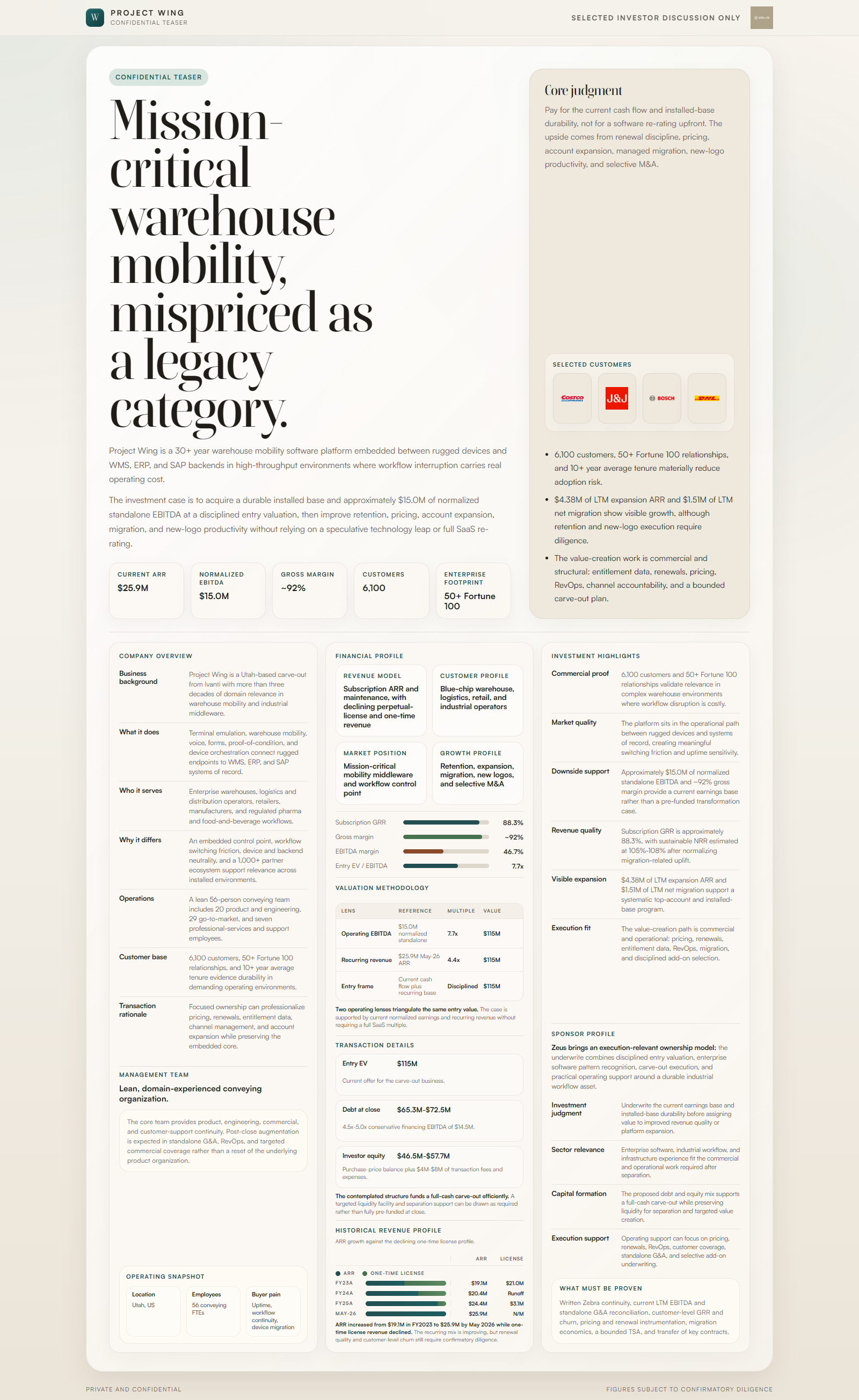
Project Wing is a 30+ year warehouse mobility software platform embedded between rugged devices and WMS, ERP, and SAP backends in high-throughput environments where workflow interruption carries real operating cost.
The investment case is to acquire a durable installed base and approximately $15.0M of normalized standalone EBITDA at a disciplined entry valuation, then improve retention, pricing, account expansion, migration, and new-logo productivity without relying on a speculative technology leap or full SaaS re-rating.
Project Wing is a Utah-based carve-out from Ivanti with more than three decades of domain relevance in warehouse mobility and industrial middleware.
Terminal emulation, warehouse mobility, voice, forms, proof-of-condition, and device orchestration connect rugged endpoints to WMS, ERP, and SAP systems of record.
Enterprise warehouses, logistics and distribution operators, retailers, manufacturers, and regulated pharma and food-and-beverage workflows.
An embedded control point, workflow switching friction, device and backend neutrality, and a 1,000+ partner ecosystem support relevance across installed environments.
A lean 56-person conveying team includes 20 product and engineering, 29 go-to-market, and seven professional-services and support employees.
6,100 customers, 50+ Fortune 100 relationships, and 10+ year average tenure evidence durability in demanding operating environments.
Focused ownership can professionalize pricing, renewals, entitlement data, channel management, and account expansion while preserving the embedded core.
The core team provides product, engineering, commercial, and customer-support continuity. Post-close augmentation is expected in standalone G&A, RevOps, and targeted commercial coverage rather than a reset of the underlying product organization.
6,100 customers and 50+ Fortune 100 relationships validate relevance in complex warehouse environments where workflow disruption is costly.
The platform sits in the operational path between rugged devices and systems of record, creating meaningful switching friction and uptime sensitivity.
Approximately $15.0M of normalized standalone EBITDA and ~92% gross margin provide a current earnings base rather than a pre-funded transformation case.
Subscription GRR is approximately 88.3%, with sustainable NRR estimated at 105%-108% after normalizing migration-related uplift.
$4.38M of LTM expansion ARR and $1.51M of LTM net migration support a systematic top-account and installed-base program.
The value-creation path is commercial and operational: pricing, renewals, entitlement data, RevOps, migration, and disciplined add-on selection.
What must be proven
Written Zebra continuity, current LTM EBITDA and standalone G&A reconciliation, customer-level GRR and churn, pricing and renewal instrumentation, migration economics, a bounded TSA, and transfer of key contracts.